
Fields of Mistria Farm Layout & Design: Starter to Cozy
Plan your Fields of Mistria farm layout from starter to cozy: zoning diagrams, one daily route, sprinkler coverage, community inspiration, and a checklist.
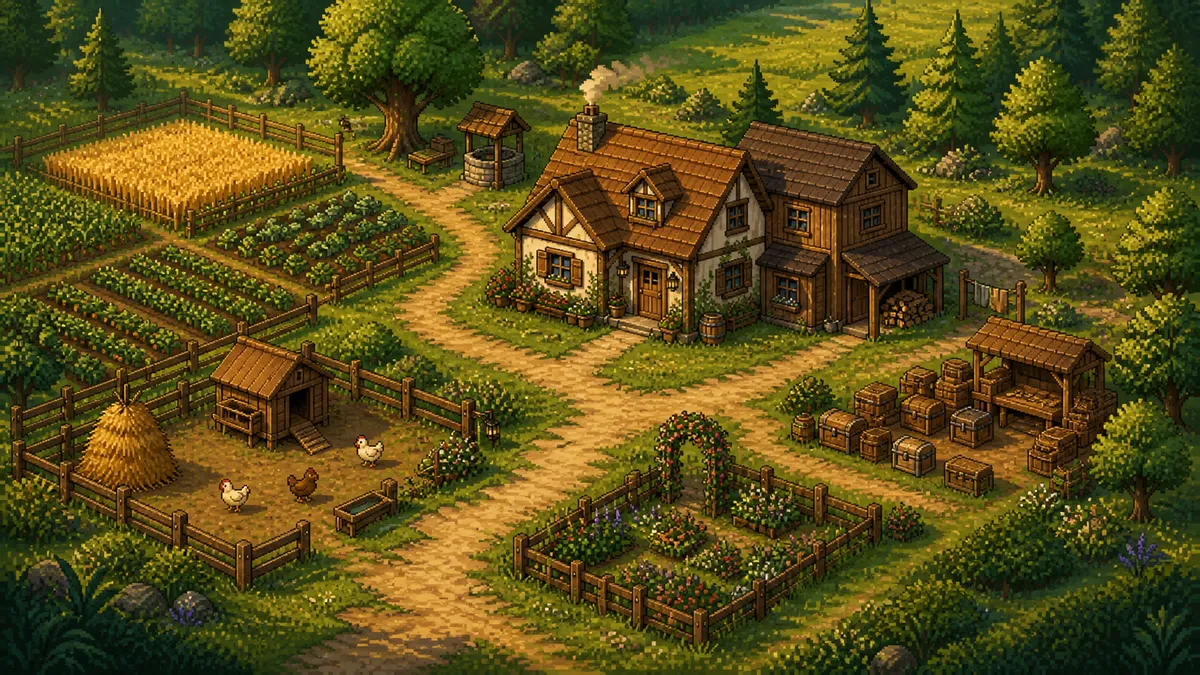
An effective Fields of Mistria farm layout begins with a route you can understand at a glance: crops, animals, supplies, and a future idea all have a place. That makes an early farm easier to use and leaves a long-term farm room to become personal.
This guide treats community posts as inspiration, not as blueprints or evidence of game rules. The examples below are useful because they reveal the questions players ask while planning: what should stay connected, which areas deserve open space, and how can a farm remain inviting after it grows? No community image, video frame, caption, or game asset is reproduced here.
Looking for finished examples rather than a planning method? Browse the Fields of Mistria farm layout ideas collection for community-led visual inspiration.
Start with zones and one main route
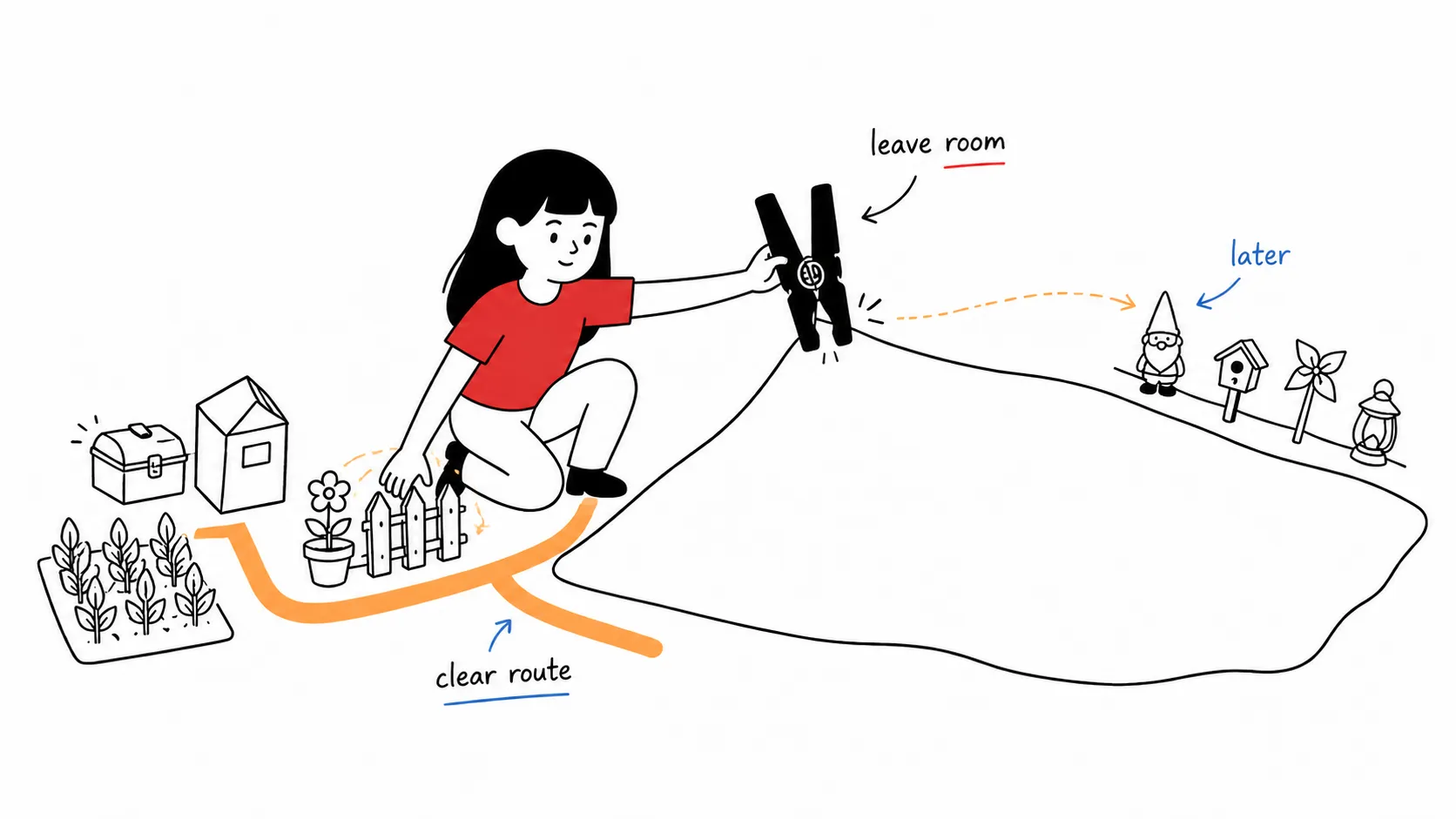
Before choosing decorations, sketch five simple zones: crops, buildings, animals, storage, and a flexible decorative or expansion area. Then draw one main route that links the places you expect to visit most often. A readable spine is more valuable than a symmetrical map: it helps you decide where a side path is useful and where an empty gap should remain empty.
Put crop plots together rather than scattering them across every corner. Group farm buildings into a recognisable working cluster, and give the animal area its own edge or pocket so it reads as a destination instead of an obstacle. Keep chests and other storage near the task that produces or uses those items, without turning the main path into a maze. Finally, reserve a small open zone. It can become a new work area later, or simply protect the calm of the design. When you are ready to size the animal pocket, the Fields of Mistria coop guide compares coop sizes, costs, and capacity, and explains how to move a coop without breaking this layout.
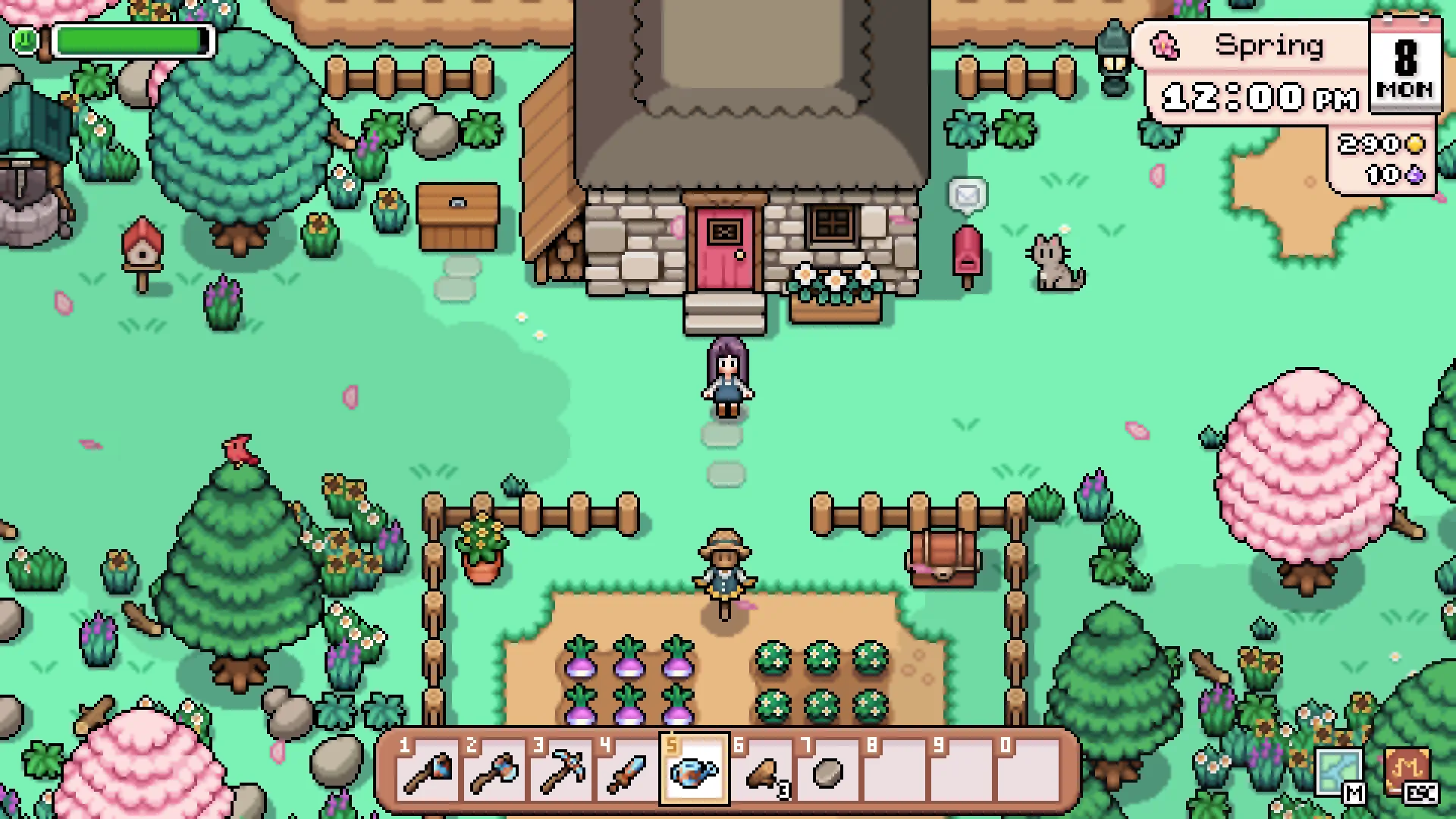 Screenshot courtesy of NPC Studio.
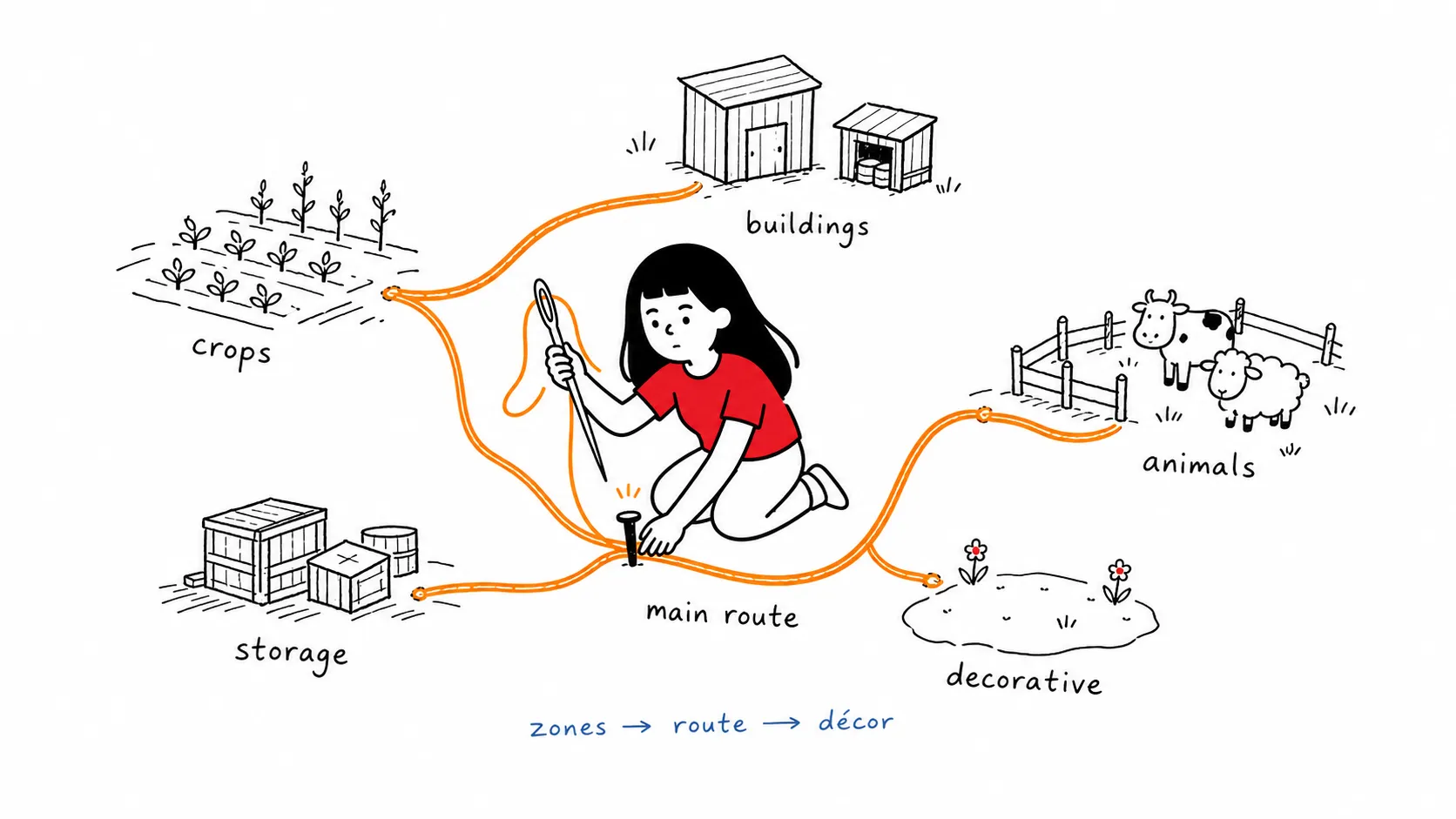
The diagram is deliberately a relationship map, not a scale plan. Its value is the sequence: zones first, route second, decoration last. Use it to test your own priorities rather than to infer footprints, ranges, costs, or unlocks.
Plan sprinkler coverage before paths
If you use Water Sprite Statues, mark their coverage before you commit to fences, paths, or a decorative border. One statue automatically waters crops in a two-tile radius when it is supplied with an Essence Stone. Keep a short route to the statue so topping it up does not turn a tidy crop area into an awkward detour.
Treat this as a coverage-zone decision, not a reason to make every crop block identical. Start with the patch you visit most often, leave room for future crop changes, and place visual details around the edge of the watered area rather than through its working center.
The same coverage-first thinking applies to your indoor growing space: before you fix paths around it, work out your greenhouse placement first so its entrance meets your main route instead of sitting at the end of a detour.
Starter Work Route
The Starter Work Route is for a farm that needs to work immediately without committing every piece of land to a permanent identity. Place your home and the everyday building cluster on one side of a short, obvious path. Let a compact crop block sit directly off that route, with storage on the crop-facing side of the working cluster. Put the animal zone nearby but slightly apart, so its fences and gates do not interrupt the central walk.
If you would rather test this on a grid than on paper, the Fields of Mistria farm layout planner lets you block out the same zones and route before you move anything in your save. For the storage side of this route, including task-based chest nodes and a temporary inbox, see this farm storage planning guide.
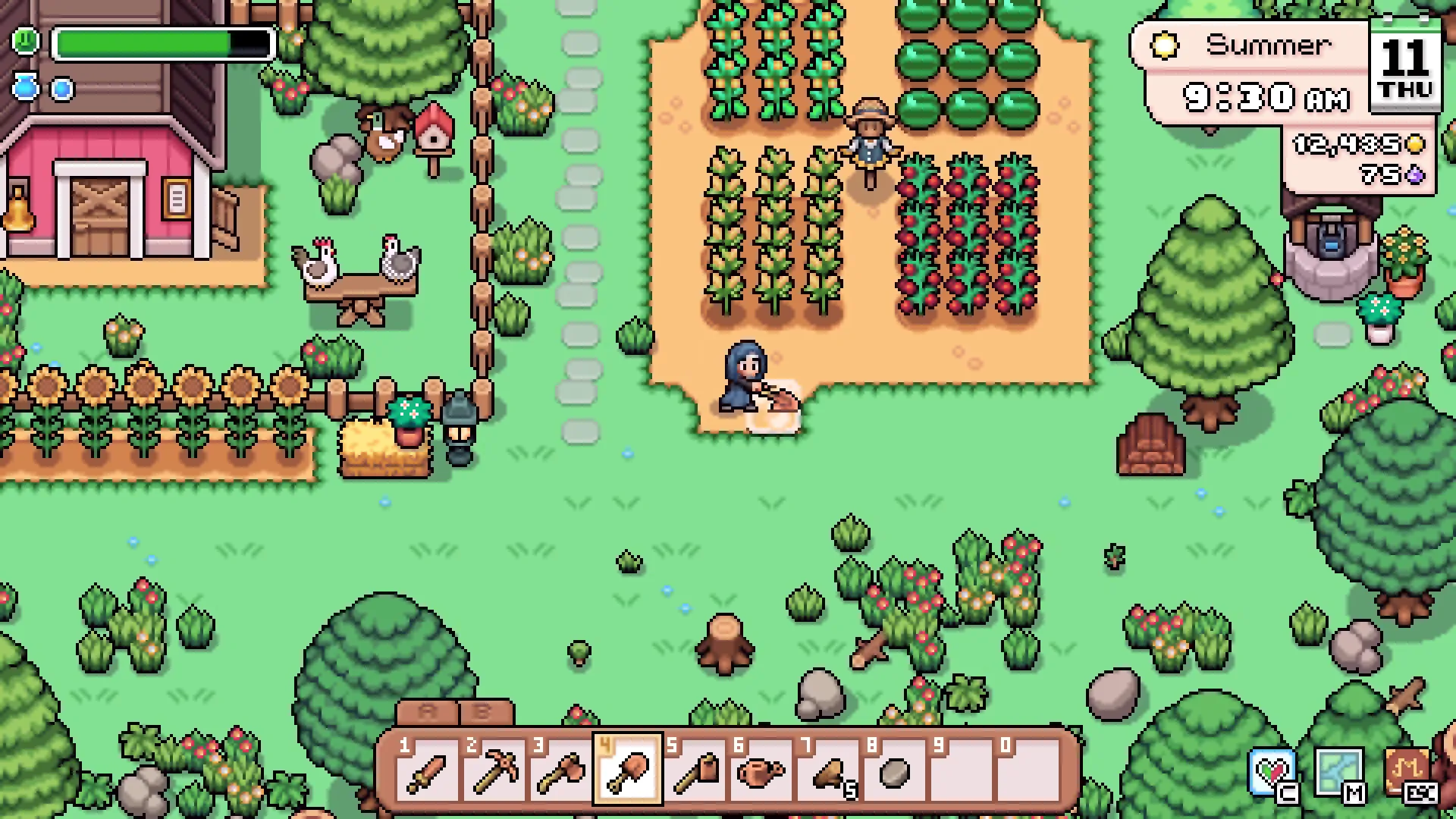 Screenshot courtesy of NPC Studio.
In this pattern, the most important design decision is a blank patch beside the route. It is not wasted space. It gives you a place to add a new priority later without pulling apart the crop area, building area, and animal area you already understand. Keep decorative items at entrances, corners, and path edges at first; they frame the route while remaining easy to move when the farm changes.
Community inspiration: First Farm Layout
This post is a prompt to solve the daily route before chasing a finished aesthetic. Take its idea of a clear high-use core and an uncommitted edge, not the exact arrangement. A first layout needs breathing room to be revised as your priorities settle.
Source: First Farm Layout — ImBadAtNames_01 (Reddit, opens in a new tab)Community inspiration: Year 2 Spring Farm Design
Use this as a bridge between a starter farm and a more intentional one. The useful question is not “how do I copy it?” but “can I still see my work zones and main route after I add more?” A starter route remains valuable when it becomes the backbone of later paths rather than a corridor boxed in by new projects.
Source: Year 2 Spring Farm Design (40 hours) — xoxoladygaga (Reddit, opens in a new tab)Progression / Crop Focus
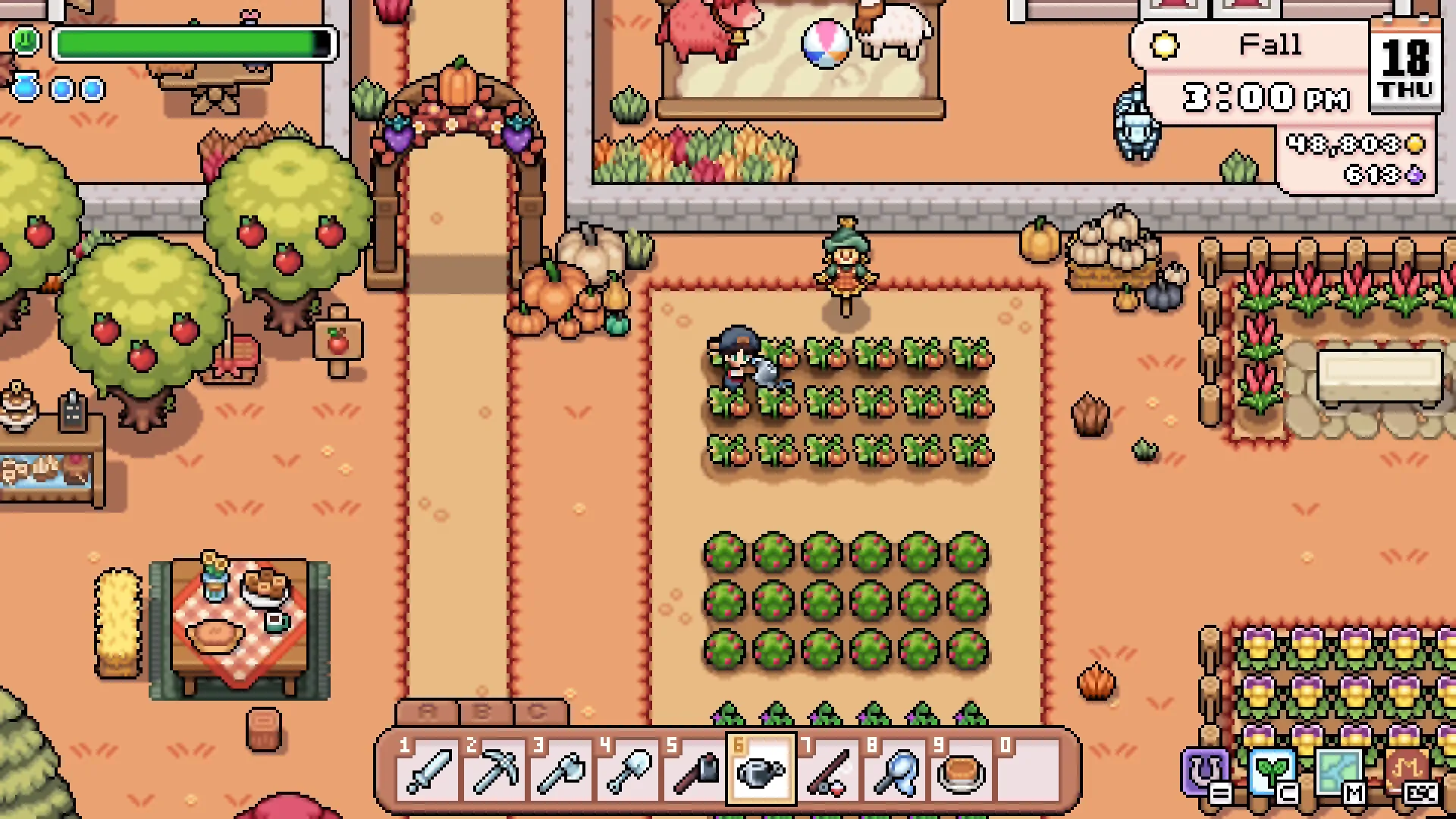
Choose a Progression / Crop Focus farm layout when crops and expandable work space are the visual center of the farm. Establish one broad crop district as the anchor, then arrange buildings and storage along a side of that district instead of dropping them through the middle. The main route should run beside the crops, with short branches to the building cluster and animal pocket. This preserves a clean view of the farm’s primary work area while keeping its supporting tasks close.
 Screenshot courtesy of NPC Studio.
For this style, use edges as boundaries. A row of trees, a fence line, or a decorative strip can mark the transition from crops to a quieter area without making the farm feel closed. Place animal buildings together at one end of the route and keep their open surroundings distinct from crop rows. Give storage a practical home at the crop-to-building threshold, where it can support either direction. Leave one edge intentionally unfinished so the layout can grow without breaking its central axis. When that unfinished edge becomes new land, plan the expansion before you break ground so the new zone joins your existing route instead of cutting across it.
Community inspiration: Farm Layout (Year 4, Diamond Town Rank)
The post is useful as a crop-led, in-progress composition: a large functional area can establish the farm’s main axis, while trees and a still-evolving ranch edge create boundaries. Its author describes their own save, not a universal capacity or optimal answer. The planning lesson is simply to let one major zone lead, and let unfinished space remain an intentional part of the picture.
Source: Farm Layout (Year 4, Diamond Town Rank) — Smolsass (Reddit, opens in a new tab)Community inspiration: 10 Best Farm Layout Tips!
This planning video is a useful outside perspective on sequencing: set broad zones, connect the route, then make visual choices. Treat it as a source of questions rather than current mechanical guidance. In particular, it can help you audit whether a building cluster has severed a crop route or whether a decorative edge still leaves a clear place for later changes.
Source: Fields of Mistria - 10 Best Farm Layout Tips! — Cozy With Toxi (YouTube, opens in a new tab)Cozy / Decorative
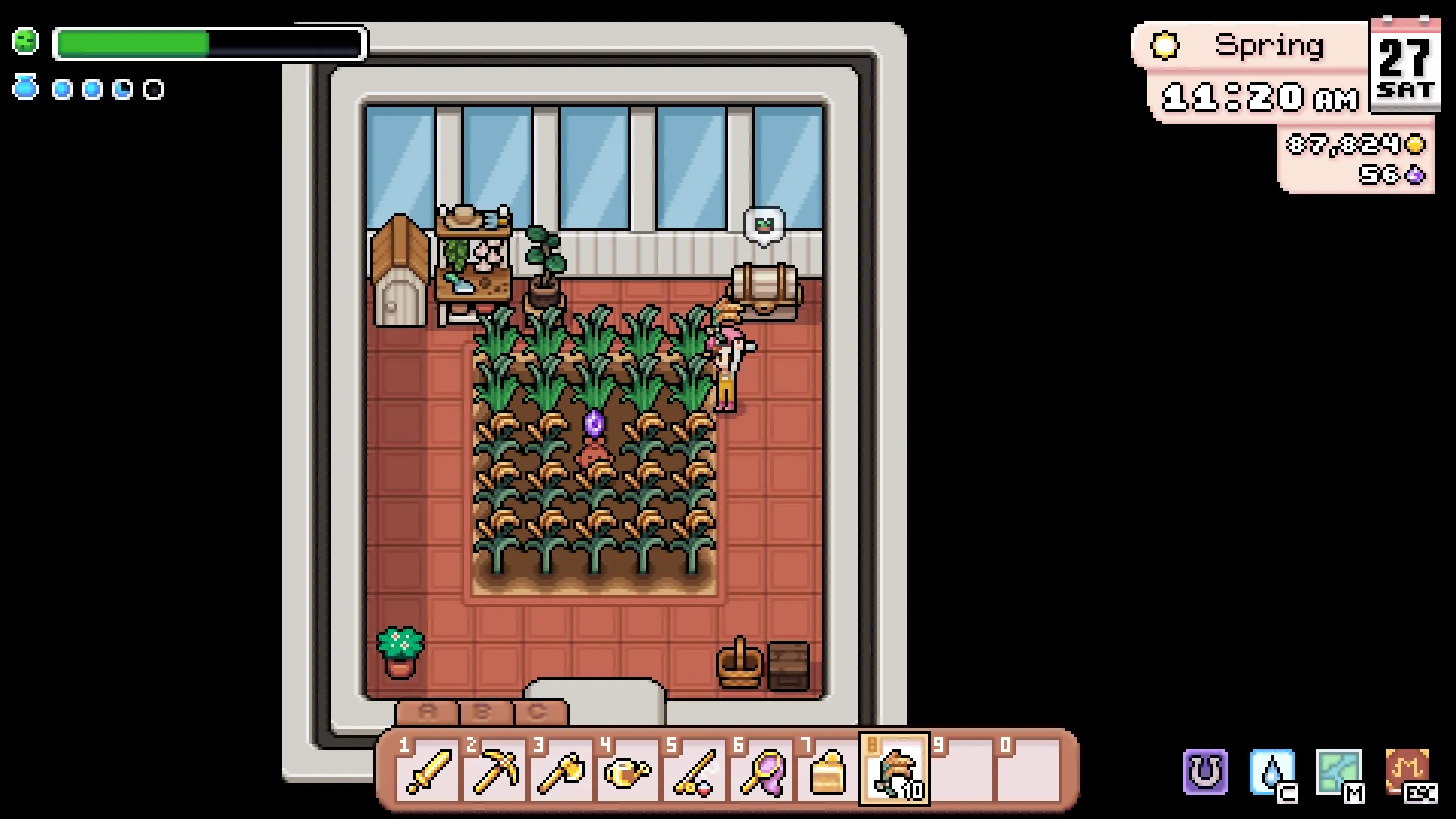
A Cozy / Decorative farm layout starts with atmosphere, but it still benefits from firm functional boundaries. Choose a visual idea—an orchard lane, a cottage garden, a rustic yard, or a quiet flower court—and make it the transition between work zones rather than an afterthought. Keep crops in a tidy pocket, set buildings into a small neighborhood, and place animals in a fenced scene with its own approach. Storage belongs close to the working neighborhood, where it can be practical without becoming the focal point of a decorative view.
 Screenshot courtesy of NPC Studio.
Here, the main route can bend and pause more than in a crop-first design. Use it to create arrivals: a path toward the house, a turn into the animal area, or a small garden crossing. Avoid decorating every open square. A clear strip beside a building, a calm lawn around a fence, or an unplanted corner beside the path gives the eye somewhere to rest and preserves room to revise the farm’s story later. If you would rather start from finished compositions, browse the farm layout ideas collection and adapt one zone at a time.
Community inspiration: cute fields of mistria farm ♡
This Pin is a visual-inspiration reference for players searching for a softer, more decorative farm mood. The planning question it surfaces is valuable: how can flowers, trees, and fences make a farm feel cared for without obscuring its useful zones? Borrow the principle of reserving visual pockets and soft edges; do not reproduce the original image or treat its comments as game rules.
Source: cute fields of mistria farm ♡ — liza ♡ / @lizaxiv (Pinterest, opens in a new tab)Community inspiration: I DECORATED MY ENTIRE FARM in Fields of Mistria
This full-farm decorating video shows how a theme can be built in layers. Start with zones that remain easy to recognise, then use planting, fences, and open space to give them a shared mood. The original video remains the source for its creator’s process.
Source: I DECORATED MY ENTIRE FARM in Fields of Mistria ✨🌱 — Payton’sCorner (YouTube, opens in a new tab)Farm Design Principles
Choose a theme that supports your routine
Start with one idea you can describe in a sentence: an orchard lane, a flower courtyard, or a compact working farm. Use that idea to choose where decoration belongs, while keeping the crop, animal, and storage routes readable. A starter farm can establish its theme at the entrance first; it does not need a finished decorative border around every zone.
Repeat a small set of visual choices
Choose a few materials, colors, or planting shapes and repeat them at important turns. A shared fence style or a recurring flower edge can connect separate areas without making them identical. On a crop-focused farm, keep this repetition around the working district rather than across the beds. Compare the view from the main path before adding more detail: too many competing patterns can hide the route you carefully planned.
Give the farm one focal point at a time
Choose a place where you want the eye to pause, such as the house approach or a small garden beside a junction. Keep its surroundings quieter so that the scene reads clearly. A cozy farm benefits from several small destinations, but each should have its own breathing room. Use the community inspiration gallery to study these relationships, then adapt the idea to your own space instead of copying an entire farm.
Keep useful boundaries and unfinished space
Let trees, paths, or low decorative edges explain where one zone ends and another begins. Check that those boundaries still leave a direct way to the places you visit daily. Reserve an open strip for the next building or a change of plan; that gap can also balance a busy scene. Review the design from the entrance and along your daily loop. If a decoration makes either route harder to follow, move it before committing to the rest of the theme.
Crafted furniture and decor are made in Town, not on the farm, so plan where those items will land before you fill your last open strip. The Fields of Mistria crafting guide shows where the Woodcrafting stations are and what they make.
Full Farm Layout References & Inspiration
Use the farm overview near the start of this guide as a whole-farm reference: first trace its main route, then notice how the crop, building, animal, and open areas stay legible from one view. The goal is not to duplicate a map square for square, but to choose a composition you can adapt to the space and items in your own save.
Cute, Cozy Full-Farm View
For a cute farm layout, let a small decorative scene sit between practical zones instead of covering every open tile. A house approach, orchard lane, flower pocket, or fenced animal corner can give the full farm a softer identity while crops and storage remain easy to spot. Repeat one or two visual cues along the main route, then leave calm gaps around them so the farm still reads clearly from a whole-farm view.
Neat, Efficient Full-Farm View
For a neat, efficient layout, make the crop district and work route the first things you can identify at a glance. Keep buildings in a compact cluster beside the route, place animal spaces at one edge, and let storage support the transition between those areas. This direction is useful when you want a tidy full-farm view without treating symmetry as a requirement: clear boundaries and short connections matter more than matching shapes.
Decorative Details as Landmarks
Use one decorative detail to mark an arrival, a wall, or the edge of a quiet corner rather than scattering focal pieces across the farm. If a Nautical Compass or Dragon Wall Head Piece is part of the look you want to try, build a small path, wall, or open viewing space around that one detail and keep the surrounding route readable. This is a composition prompt, not guidance about item availability, placement rules, or unlock conditions.
Whole-Farm Inspiration Checklist
- From one view, can you find the main route, crop area, buildings, and animal area? If not, simplify a boundary before adding more decoration.
- Does the theme have one clear focal area? Give a cute garden, a neat work yard, or a decorative landmark room to stand out instead of competing with every zone.
- Is there still one flexible edge or open pocket? Keeping a visible gap makes a finished-looking farm easier to revise when your priorities change.
A quick farm layout review before you commit
Walk the main route in your mind from the entrance to crops, buildings, animals, and storage. If you must zigzag through an unrelated zone, simplify the path. If a building or fence makes a whole section feel isolated, add a branch route or move the boundary. If the farm already feels crowded, identify one area to leave unadorned rather than adding another feature.
The best Fields of Mistria farm layout is the one that reflects what you enjoy doing today and can still change tomorrow. Start with a work route, choose whether crops or atmosphere lead the composition, and let community creations give you questions—not a map you have to copy.
Related guides
Try the Fields of Mistria farm layout planner to sketch your route, crop zones, buildings, and expansion space before you build.
Plan the spaces around your daily tasks with the Fields of Mistria crafting table guide, Fields of Mistria house upgrades, and Fields of Mistria coop placement.
When you finish planning the daily route, use the Fields of Mistria gift guide to decide what to bring when you visit town.
Watch & Learn
See the planning problem in motion
These verified YouTube links add a creator’s visual context. Use them for workflow ideas, and check current in-game text or NPC Studio sources before treating a mechanic as fact.
Fields of Mistria - 10 Best Farm Layout Tips!
Cozy With Toxi
Useful when you want to watch a farm move from a rough plan toward paths and decoration without treating one layout as mandatory.
Watch on YouTubeI DECORATED MY ENTIRE FARM in Fields of Mistria
Payton'sCorner
Useful for seeing how one visual theme can connect several functional areas across a finished farm.
Watch on YouTube